
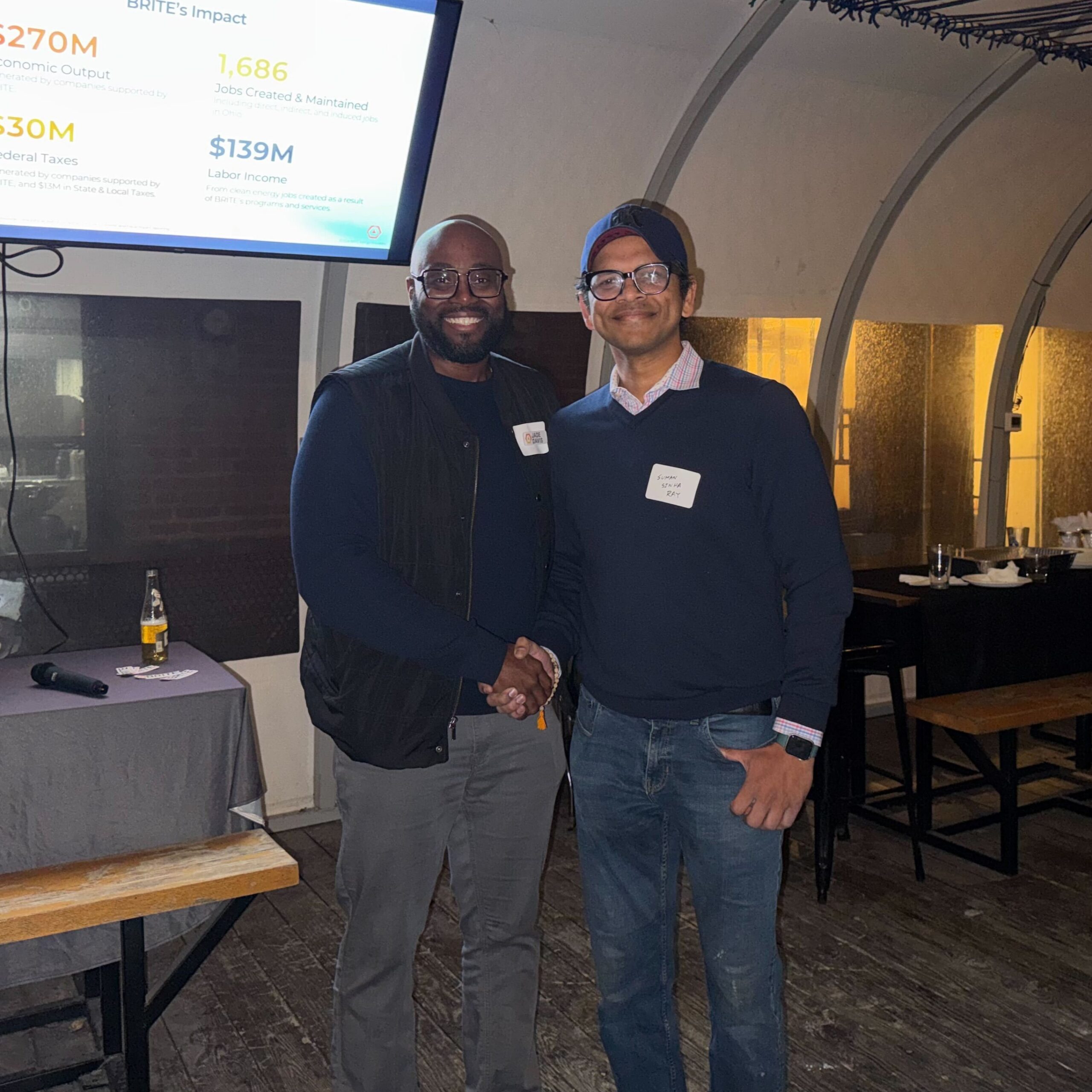
BRITE: Suman, first of all, congratulations on the pitch win. To start, can you tell us a bit about your background and the spark that led to the creation of Cabomba?
Suman: I was born in India, did my undergrad in mechanical engineering, and came to the U.S. for my PhD. I eventually joined USG Corporation, where I was running the commercialization side. Before that, I never really thought about commercialization, but once I joined, I realized I was being trained like an MBA but with a researcher’s bone.
The spark for Cabomba actually involved my brother, who was doing a PhD at the same university. We worked on a problem during his PhD, and when COVID hit in 2021, we saw the challenge of the N95 mask. Even when people had them, it was almost impossible to keep them on your face because they are so hard to breathe through. We asked: what if we can take a cloth mask and add our lab technology? Could we get N95 efficiency while breathing as easily as a cloth mask?
It worked exactly as we hoped. That is when the light went off. Our lung is just a pressure differential. If you have a lower pressure difference, you use lower energy, but you filter better. I realized the same thing applies to machines: HVAC, water, all of it. That was the spark.
BRITE: In your pitch, you identified data centers as your beachhead market. Why is that the right place to start?
Suman: Data centers are supposed to be the buildings of the future, but the infrastructure supporting them was not built for the future. They are locked into old systems. The biggest problems for a data center are actually quite mundane: having access to clean air and clean water. They need cleanroom-style air, and they need to reuse water because they are incredibly water-hungry to stay cool.
In a data center, a minute of downtime is $9,000 to $10,000. We are enabling regular, old infrastructure to outperform. We solve the water body issue and allow them to get that high-level cooling efficiency without needing super-specialized construction.
You want the people who build your house to be able to go and build a data center, and that is what we are enabling.
BRITE: Let’s talk about the tech. You have a patented non-woven coating process. How does that differ from traditional manufacturing?
Suman: We wanted to be Opex Light and Capex Light. If we went and built our own factory, it would be very hard to switch quickly depending on the solution a customer needs. So, our patent is actually for the manufacturing method.
We leverage the existing network of non-woven manufacturing companies in the U.S. We basically rent their lines and bring in our coating system that sits on their existing line. Depending on the need, whether someone needs HEPA-type efficiency or 95% efficiency, we tune the layers.
Importantly, we did not want the installer, the guy who changes the filter, to be specialized. When you or I change a furnace filter, we have zero knowledge of how a furnace works. We kept the same form factor, so he just goes in and takes it out. We wanted to take the specialty out of specialized filtration.
BRITE: You mentioned wanting to achieve software-company-like efficiency. How does that look for a hardware company?
Suman: This is the ideology: I want the amount of revenue per unit employee to mirror a software company. I want to keep the team super small and highly efficient. You see these coding companies hitting 1 million in ARR per unit employee. To do that in hardware, you have to be agilent. You have to focus on the supply chain and tool manufacturing rather than heavy overhead.
BRITE: Tell us about the team. You mentioned it’s a well-grounded group.
Suman: We are not like 20-year-olds. We are three co-founders: me, Kumar Natya Saeer, and Sumit Senare. Sumit is my brother, which helps, though I try to never argue with him because brothers always try to get the upper hand!
Kumar was the Vice President of Innovation at USG Corporation. He has a PhD from Cornell but spent his life building businesses. In my previous job, he was actually my boss. Sumit is a pure academic researcher focused on fundamental tools. I kind of exist in both worlds. I understand what Sumit is saying, and I understand what Kumar is saying, and I can put on either hat. We are idealists, but at the same time, we are very grounded in reality.
BRITE: Finally, the name Cabomba. Where did that come from?
Suman: When I was an undergrad in India, I had a waterborne disease that almost killed me. So I’ve always thought water was the biggest thing. When we were forming the company, we found this very unassuming marine organism called Cabomba. It’s a plant that filters aquarium water and seawater without disrupting the ecosystem. It just does its job and keeps everybody healthy. We want to be the Intel Inside of the filtration world: the Cabomba inside.
BRITE: Suman, we are thrilled to have Cabomba in the BRITE ecosystem. Any final thoughts on the journey so far?
Suman: Knowing how to change and dance to the tune at the right time is the toughest thing for founders. There is no shame in changing course. We started looking at drinking water, then HVAC for COVID, and finally pivoted to industrial data centers as AI took off. My biggest learning is that you have to be able to pivot.
And having you guys at BRITE as a harbinger of our message helps us quite a bit. It’s exhausting to bridge the gap to the financial world, and the translation help we got through the Elevate program has been invaluable. We have high hopes for what we can do together.